Ponderings from an Oil Manufacturer

Colleen-Maxey- From the Train berwick Upon Tweed Near Border Area between England and Scotland

A View From the Train

I am writing this from an express train traveling from London to Edinburgh. It is the third week of January and the snow is unusually deep here in Britain. I am on an adventure from my home base at Jack Richeson and Co., Inc.in Kimberly Wisconsin to visit retailers and suppliers in Britain and then on to the famous Paperworld Exhibition in Frankfurt Germany where I will visit with more suppliers and potential suppliers as well as have never ending cups of Coffee and Tea with Retailer Friends and Competitor Friends I happen across at the Exhibition.

When I first considered making a contribution to the blog, it was with the thought of talking about the amazing and exceptional way Richeson manufactures our Oil Paint. I say that a bit tongue in cheek, because as a salesperson I know virtually every manufacturer will say the same. From my comfortable perch on this train I feel far more inclined to delay what I truly believe is a justifiable “sell job” for a future blog. Instead I would prefer to share with you a secret about the many many manufacturers and retailers that make or sell the many ranges of Mediums you use in the pursuit of your passion.

Colleen-Maxey-Scenic Brook in Northumberland near Unison

Scenic Brook in Northumberland near Unison

The secret – we love making and or selling paint! Most of us are passionate about what we do. In my work I have the pleasure of talking to Retailers and Manufacturer Competitors from all over this globe. I am struck by a common thread ……the vast majority (there will always be exceptions) are not in the business of manufacturing or selling artist materials to become wealthy. Make no mistake….yes …..we all want to make a living….put a roof over our heads and feed our families…..but get wealthy…….not in Artist Materials. Rather for the majority I believe it is for the passion of serving the artist. For the passion of the art.

You see……many are artists in their own right who have ventured into the strange land of making or selling art materials out of a desire to stay close to the artist community as they earn a living and yet while under cover of darkness they pursue their art after working hours. I also know many folks involved in manufacturing who got their start as frustrated artists desperate to improve the quality of a medium but were frustrated with the materials available to them.

Colleen-Maxey-Visiting the Unison Factory Northumberland England

Visiting the Unison Factory Northumberland England

Others are “technicians” such as myself who admire artists, love spending time with those with artistic talent….feeling that somehow if we spend time with these amazing people that just by being in their presence and basking in the glow of their talent, we could have a bit of it rub off on us. Speaking for myself, I love seeing the world through the eyes of my artist friends. They have taught me to see colors and shapes in a mystical magical way I had not been able to see them previously.

There is however a dark side to the secret I share with you. An ugliness has been creeping into the passionate Retailer and Manufacturer’s pursuit to serve the Artist Community. The never ending push to drive down the cost of artist materials over the recent years is at risk of seriously impacting quality. You may well ask……Is competitive price reduction such a bad thing? After all…..I confess…..I too must shop for the best value I can afford.

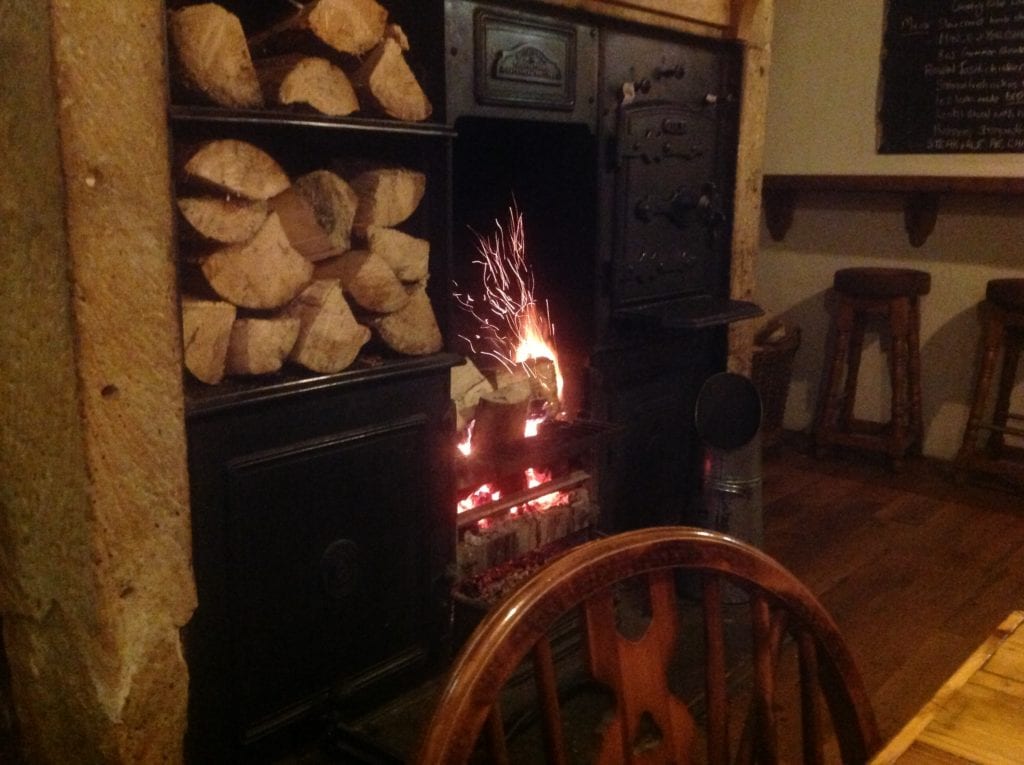
Colleen-Maxey-Fir in the pub  B and B after my long train ride

Fir in the pub B and B after my long train ride

The answer I believe is “it can be a bad thing”….. competitive price reduction crosses the line of being beneficial when quality is sacrificed. As the market pushes price lower and lower quality eventually diminishes. I recall a phone call I received on day from a very frustrated University Instructor. She had just purchased one of our 12 inch manikins from a local retailer. It seems she paid somewhere around $8.95. She felt the need to express her disappointment in the quality change over the last twenty years. It just wasn’t what it used to be….and she was understandably irritated. I agreed with her. The quality of manikins is NOT what it was twenty years ago. Twenty years ago the same manikins cost $24.95. As price was forced down, quality went out the window in order to produce a manikin that could sell to artists at $8.95. The market would no longer accept a manikin even at a high quality that was significantly more expensive than $8.95.

Colleen-Maxey-Crossing the Border from England to Scotland January 2013

Crossing the Border from England to Scotland January 2013

Personally I despise where the market is driving the quality of materials with lower and lower prices. I know many others in the Retail and Manufacturing end of the business who feel exactly the same way. Our company as well as many others fight to maintain the quality of our color, brush, and easel line. Purist Retail friends ache to offer quality materials, however the word on the streets is the consumer wants price at any cost. By that I refer to the cost to quality. In addition retailer after retailer are disappearing from our Main Streets as the drive to the bottom forces them to close their doors.

So where is all this rambling on a long train ride from London to Edinburgh heading? It leads me first to reflect on my own guilt at too often purchasing solely on price and neglecting quality, only to later grumble and moan because the silly thing has not functioned or lasted as I expected. I chide myself and renew a commitment to purchase the finest quality widget or thing I can possibly afford for the money available to me.

Colleen-Maxey-English Pub B and B near Unison Pastel factory

English Pub B and B near Unison Pastel factory

Secondly it leads me to urge you to demand the highest quality artist materials available for the pursuit of your art. Your reputation as a painter hinges on more than your talent. The person buying your work expects it to survive on the wall for years and years to come. Learn all you can about the materials you desire to use. Imagine – you, a spouse, or a friend are a passionate golfer. High quality gear is widely accepted as desirable to accomplish a good game. Why would you settle for anything less to accomplish a well done painting?

Enough rambling from my seat on a train in the British Countryside. Next time I will expound on our passion at Richeson for producing only the finest Oils available at a price that is affordable without the need to take out a second mortgage!!!!

Dianne Massey Dunbar Interview

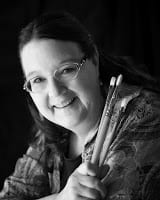
Diane Massey Dunbar Headshot

“I paint ordinary objects and scenes from everyday life. While I have the highest respect for artists who paint vistas and exquisite nudes and the like, I believe that there is a great deal of beauty in the world that often goes unnoticed. The amazing color in raindrops, the variety in fallen autumn leaves, the interesting greens one finds in a stack of French fries, there are endless opportunity for paintings. My hope is that people view the world just a little bit differently after seeing my paintings.”

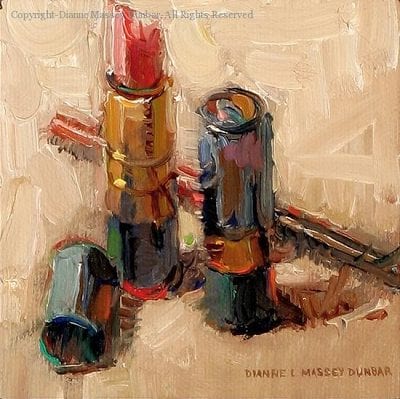
"Red" by Diane Massey Dunbar OPA - 4x4 -Oil

“Red” by Diane Massey Dunbar OPA – 4×4 Oil

I’m a huge fan of Dianne Massey Dunbar. Her work is exciting and joyful. It reminds me somewhat of Wayne Thiebaud’s work, but I find Dunbar’s work every bit as exhilarating. Thiebaud speaks of painting as celebrating the joy of living, the thrill of experimentation and expectation, I think Dianne would fully agree with that. Her works ooze with enthusiasm and controlled recklessness.

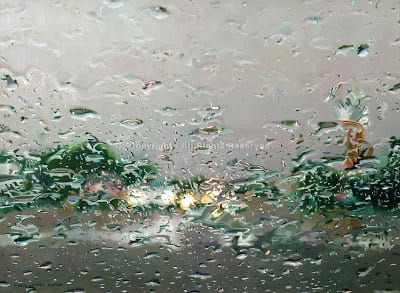
What is so amazing to me is her fabulous ability to take the most mundane of objects and transform them into delectable treats. How can someone take a simple tube of lipstick, or plain glass bottles, or even raindrops on a windshield, and transform those things into objects of desire…paintings sought after and cherished? Dunbar does it and makes it look easy. How she does it is what this interview is about.

"Driving Through A Downpour" by Diane Massey Dunbar OPA - 12x16

“Driving Through A Downpour” by Diane Massey Dunbar OPA – 12×16

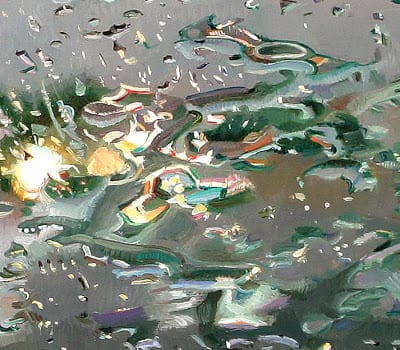
"Driving Through A Downpour (Detail of raindrops on windshield)" by Diane Massey Dunbar OPA - 12x16

“Driving Through A Downpour (Detail)” by Diane Massey Dunbar OPA – 12×16

Not only is Dianne extremely thorough, even fastidious in her preliminary work for each painting, but what is so admirable is her ability to take risks…to try new things. I talk to my students about not being afraid to fail, but Dianne lives in that world with every painting. Just examining a “simple” raindrop she has painted, I can only shake my head and ask, “How does she do it?” Each individual drop is not only a masterwork of texture but is also full of reflected color. Paralyzing fear must be thoroughly conquered when attempting a painting such as Driving Through a Downpour. Quite amazing.

Mark Smith, co-owner of the Greenhouse Gallery of Fine Art in San Antonio, said, “To view one of Dianne’s paintings is to experience complexity in its most artistic form. Most often, her choice of subject matter is quite complex, challenging and can be categorized as “crazy”. However, this type of complexity is the stage that most accurately reveals Dianne’s stunning sense of color and expert brushwork. Dianne is a master of articulating her inspiration and the “story” that she finds in the most mundane and overlooked objects and moments.”

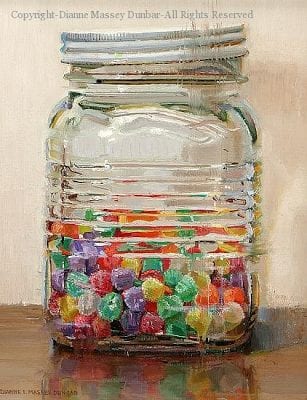
"Gumdrops" by Diane Massey Dunbar OPA - 10x18

“Gumdrops” by Diane Massey Dunbar OPA – 10×18

I wondered how she went about selecting her subjects…”I try to remain open to what I consider interesting subject matter. If I am not interested in the subject before I paint it, I have found the resulting painting looks flat. I carry a small camera with me wherever I go, and when I see something that catches my eye. I photograph it. I may or may not decide to paint the subject matter, but at least I have a subject to consider. My still life’s are painted from the objects; the other material is painted from photos. When I take photos I don’t limit myself to one or two. I may take twenty or thirty of the same subject, from different angles, cropping them, expanding them and bracketing them. Once I have an idea that I like, I then take the photos or the objects and work on designing the painting. So, I would say the composition or design of the painting is very important when selecting a subject. If the shapes and composition are not strong to begin with, it will not matter how fancy the brushwork, or sophisticated the color scheme or values. The painting will not work.”

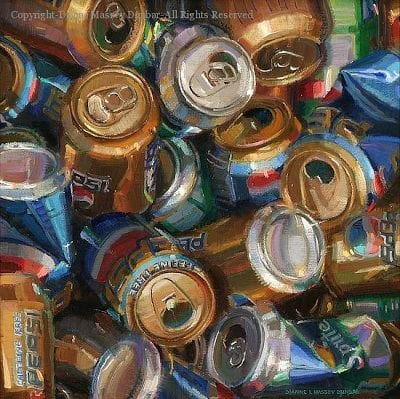
"Cans" - 12x12 - Diane Massey Dunbar OPA

“Cans” – 12×12 – Diane Massey Dunbar OPA

I will not be featuring Dianne’s complete interview here since it is quite lengthy. Her thoughtful answers have actually sparked topic ideas for future blogs, so you’ll be hearing more from her in the future.
 

And now more from Dianne Massey Dunbar…

“I want to thank John Pototschnik, whose work I have been watching for some time now and greatly admire, for asking me to answer a few questions. I have tried to answer these questions honestly and openly and I truly hope that my comments are helpful.”

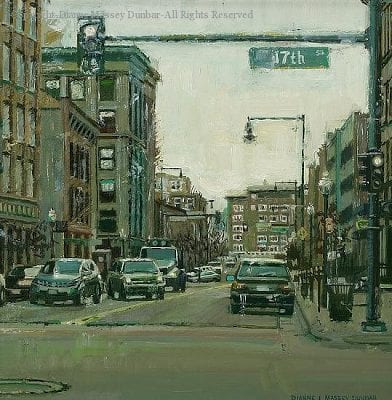
"Cityscape In Green" - 8x8 - Diane Massey Dunbar OPA

“Cityscape In Green” – 8×8 – Diane Massey Dunbar OPA

How would you define your role as an artist?  I think we all have an important place in the world at large and are equipped with unique skills and resources. Some of us are called to be doctors, others to be lawmakers or dancers or carpenters or electricians or teachers or florists. My world, my role, is to paint; to use my training and whatever talent I have to create images that are meaningful to me and hopefully have an impact on others. In a way it is like storytelling but my paintings are my voice. There are other aspects to the role of an artist beyond painting that may include encouraging fellow artists, leadership, teaching and involvement. Primarily through, I need to show up at the easel.

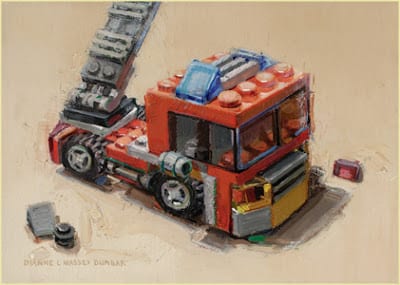
"Fire Engine" by Diane Massey Dunbar OPA - 5x7

“Fire Engine” by Diane Massey Dunbar OPA – 5×7

How much of your work is intellectual vs. emotional…and how would you define the difference?   I would define intellectual as rational, deliberate, thoughtful and thought out, planned and intentional. I believe it includes problem solving that in turn fuels creativity. I would define emotional as one’s personal likes and dislikes, opinions, sentimentality, excitement, spontaneity, responsiveness and our relational selves. As for those rare moments of inspiration, well I think they are largely emotional, but I also believe they result from an intellectual process. In my work, it takes both the intellectual and the emotional to create a painting.

For me, the intellectual part of painting is the process of designing the painting, the drawing involved, and the problem solving along the way. It is not sentimental and it frequently is not much fun. There is skill and experience that an artist draws on, and every painting, no matter how well it has been thought out, has an area somewhere that is troublesome. There are times when work is tedious or even boring. The emotional part of painting is for me what I like and don’t like, the subject matter that I paint, the thinness or thickness of paint, the “play” time I have with a painting, and the colors I may choose. And for good or for bad, I emotionally invest in my paintings.

Finding subject matter that is exciting is personal. I am drawn to simple common images: candy bars, cupcakes, rain on my windshield, jars, dishes, road crews, and reflections. After that, almost all of my preparation for each painting is intellectual and frankly a little tiresome. I study various compositions and value arrangements for my chosen subject matter long before I put brush to canvas. I tape the value studies upside down in my kitchen and study them to see if the design and the shapes are working. Once I have a design, only then do I begin painting. And for me, the beginning and early stages of a painting tend to be thoughtful and deliberate and even a little intimidating.

However, I absolutely love to play with paint, so when I have a painting far enough along, I can then begin to have fun with it. I might decide to smear paint, or flick it. I use any number of implements to play with paint, from the jagged edge of gum wrappers to torn pieces of paper towel rolls to palette knives to inexpensive brushes that I have cut gaps in. Today I experimented with my rubber kitchen spatula (I had fun but unfortunately was not happy with the result!).

I think non-artists have a notion that art is the result of “inspiration”. Well, there are times of inspiration, when instinct takes over and something happens on a canvas that I probably can never do again but I look at it in wonder. However, those times are few and far between for me. Being an artist is very much like other careers, there is leaning and thinking and hard work involved.

"From The Outside Looking In (Photo Reference)"

“From The Outside Looking In (Photo Reference)”

"From The Outside Looking In (Value Study)"

“From The Outside Looking In (Value Study)”

"From The Outside Looking In" by Diane Massey Dunbar OPA - 20x20

“From The Outside Looking In” by Diane Massey Dunbar OPA – 20×20

Describe your typical block-in technique, the thoroughness of your initial drawing, and the part photography plays in your work?  I have more than one process that I use, depending on my subject matter. If I am doing a relatively simple still life, between one and three objects, I will do one or two quick thumbnails on a piece of inexpensive canvas board, and if I am happy with the shapes, I will begin to sketch those shapes in on my canvas. On the canvas, I may do a very simple sketch, or a more complete sketch, either very lightly with pencil or with a small brush. I then paint, working from background to foreground, massing in the large areas of a single value without much regard to detail. Once I have the large value shapes in, I can begin to break them down into smaller shapes, etc. I try to work on gradation and edges as I go along.

On the more complex paintings, I generally use photographs and work with a grid system. I might start with 20 or more digital images that I study. I look at the overall design, and see what happens when I zoom in or crop the images. I narrow these down to maybe the top five and I have those printed at my local camera shop. Then I make black and white Xerox copies of the color photographs. After the copies are made, I use inexpensive poster paint in white, gray and black and paint directly on the copies exactly where I think I want the light value, the medium value and the dark value. For each photograph I might do two different value studies, to see what the resultant design is. I do this by hand instead of computer because I can make all kinds of decisions when I work by hand that might go unnoticed otherwise.

Value Study For A Possible Future Work

Value Study For A Possible Future Work

Every part of that image needs to fall into one of those three values (I have been known to work with four values, but that gets very complicated). I then tape them up in my condo and live with them for a day or two, turning them upside down and sideways to see if the design is satisfactory. It is tedious, but I have found this process works for me and I have more successful paintings. After I have a design I like, then I have that photograph enlarged. However, I keep the value study because that is my “roadmap” for the painting. So, I paint the image that I have chosen, using the values of my value study. If I am working on a square canvas, I might work from an 8″x 8″ photograph, and work on a 16″x 16″ canvas, or 20″x 20″ canvas or even a 24″ square canvas. The photograph is taped to lightweight cardboard and I use a sewing needle and thread to grid the photograph so that if necessary I can move the thread aside to see what’s underneath. I usually use 1″ squares on the photograph. I grid the canvas (the canvas must be the same proportion as the photo you are working from) with very light pencil lines, usually in two or three inch squares. I then paint each square, starting from the upper left hand corner and working to the right. After my canvas is painted, then I go back and make necessary corrections, work on edges, simplifying, etc.

"Late Afternoon" by Diane Massey Dunbar OPA - 24x18

“Late Afternoon” by Diane Massey Dunbar OPA – 24×18

What colors are most often found on your palette?  I love color! So, you would find a great many colors on my palette. My ‘stock’ colors are: Titanium White, Cadmium Lemon, Cadmium Yellow Light or Medium, Cadmium Orange, Cadmium Red Light, Alizarin Crimson (permanent), Dioxazine Purple, Cerulean Blue, Cobalt Blue, Ultramarine Blue Deep, Permanent Green Light, Cadmium Green, Sap Green (permanent), Phthalo Green, Yellow Ochre, Burnt Sienna, Burnt Umber, Torrit Grey (Gamblin).

I use other colors in different situations, especially Zinc or Transparent or Flake White Replacement. There are times I really need Indian Yellow. Caucasian Flesh is a very useful color in a number of situations. I also use Venetian Red or Naphol Red and a number of other greens, especially Emerald Green Nova. I mix my blacks, but I do have a tube of black that I use if needed.

Some of these are quite transparent in nature, and some opaque. An artist needs to know the tinting power of different colors and use the intense colors sparingly (Alizarin Crimson and the Phthalos immediately come to mind). However, a lot of wonderful effects can be achieved with a more limited palette, so you do not need all these colors to produce wonderful paintings. Indeed, if you are new to painting, you would probably be best served by using a more limited palette.

"Ten" by Diane Massey Dunbar OPA - 20x20

“Ten” by Diane Massey Dunbar OPA – 20×20

"Nancy" by Diane Massey Dunbar OPA - 27x23

“Nancy” by Diane Massey Dunbar OPA – 27×23

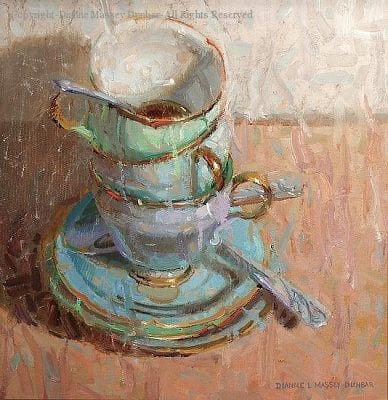
"Cups And Saucers" by Diane Massey Dunbar OPA - 10x10

“Cups And Saucers” by Diane Massey Dunbar OPA – 10×10

How do you decide on a dominating color key for a painting, and how do you maintain it?  I use the subject matter to guide this decision. If it is an overcast cloudy day, then much of my painting will be grayish. If I am painting toys, obviously the colors wil be much brighter. However, too much pure color is overwhelming. I mix almost all of my color. I reserve pure or intense color only for small splashes or small areas.

You have entered a number of significant art competitions. Why are art competitions important to you and how do you go about selecting the paintings for these shows?   I usually enter two to three art competitions per year. I started by entering local and state competitions, and when I was comfortable with those, I started entering regional and national competitions. There are two main reasons that I enter art competitions. The first one is to see how I stack up against other artists. Secondly, I enter competitions to hopefully have my work seen by other artists, collectors, galleries, and even magazines. There are other good reasons as well: meeting other artists, being inspired, and being challenged. Some art competitions have seminars that an artist can attend to learn and expand their knowledge on any number of topics. And, let’s face it, competitions can be fun! As far as selecting a painting, when I have what I feel is a good to exceptional painting and a deadline for a show that I want to enter is approaching, I will try to put the painting aside and keep it to enter in the show. Be aware that competitions can be expensive, there are entry fees, shipping and storage fees, and perhaps travel fees if you decide to attend the opening.

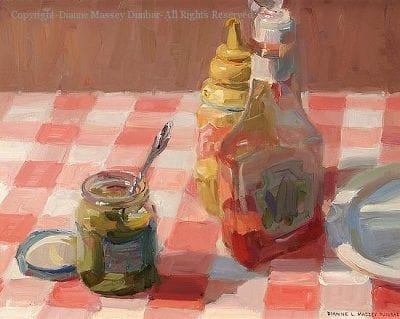
"Ketchup, Mustard and Relish" by Diane Massey Dunbar OPA - 11x14

“Ketchup, Mustard and Relish” by Diane Massey Dunbar OPA – 11×14

What advice do you have for a first-time collector?  Speaking as an artist, it is my hope that my paintings find homes where they are loved. So, I suggest that you buy a painting that you love and respond to. Also, trust your instincts. You will hopefully have it in your home for years; you will look at it over and over, perhaps seeing something different every time. So, before your worry about who the artist is, or how the colors might work in your home, look at the painting and see how you feel about it. Does the painting interest you? Do you want to get close to it and see all the beauty in the brush strokes and splashes of paint and even fingerprints? Do you find yourself thinking about a particular painting you have seen but have not yet purchased? You will know it when the right one comes along.

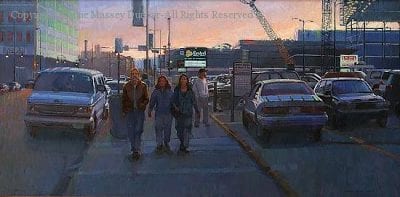
"City Sidewalk" -18x36 - Diane Massey Dunbar OPA

“City Sidewalk” -18×36 – Diane Massey Dunbar OPA

If you could spend the day with any three artists, past or present, whom would they be?  Every artist brings something different to the viewer. I admire so many artists, from Rembrandt to Wyeth, Monet to Van Gogh to Fechin. And, there are many current artists that I greatly esteem. I cannot begin to choose one over another, as they are each brilliant in their own individual way. However, I will state that for many years I struggled to appreciate the work of Vincent Van Gogh. Then, on a trip to New York, almost twenty years ago, I went to the Metropolitan Museum of Art. It was there that I saw my first Van Gogh in person. I could ‘feel’ the passion and the painting just by looking at it. I remember standing there for a very long time, with tears running down my face, finally getting it. I have never forgotten that experience. It was profound.

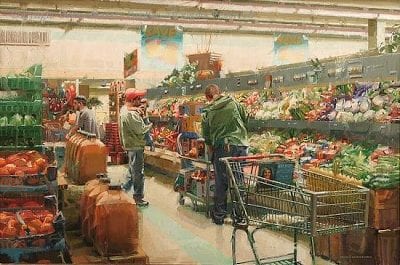
"Shopping Cart" by Diane Massey Dunbar OPA - 20x30

“Shopping Cart” by Diane Massey Dunbar OPA – 20×30

What do you think of that amazing interview, folks? Personally, I so appreciate Diane’s willingness to submit to this interview…and being so thorough in her answers. I hope you do also.

Here are important links to see more of OPA Signature Member Diane Massey Dunbar’s work:

Click here to receive John Pototschnik’s monthly newsletter

The Spirit Forges Ahead While the Brain Has To Figure It Out

"Stepping Out" by Nancy Boren

“Stepping Out” by Nancy Boren

A few years ago, I was fortunate to be involved in an unexpected conversation one day at my studio with an artist friend. I didn’t know when we started talking that the next few minutes would so significantly sharpen my understanding of one aspect of my painting. We casually looked through a group of my paintings while she offered her observations.


"San Patricio Church" by Nancy Boren

“San Patricio Church” by Nancy Boren

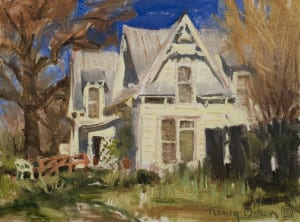
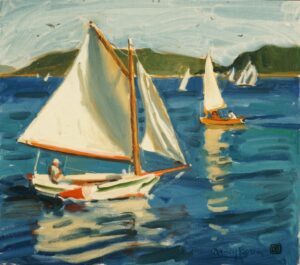
After much discussion, we both simultaneously realized we had stumbled upon a truth about much of my work. A common abstract thread that made sense of my varied subjects: it wasn’t so much the crisp white sail boats moving over dark blue water, big puffy clouds in turquoise skies, or white houses surrounded by greenery, but rather it was large white objects in a colorful settingthat I was painting over and over again. What an awakening! I thought I liked painting those different subjects and I do, but now I can see that they are all variations on a theme.  It’s almost like looking through a kaleidoscope; different shapes and patterns emerge, but there are always large chunks of white and scattered backgrounds of saturated color.


"House of the Little Old Lady" by Nancy Boren

“House of the Little Old Lady” by Nancy Boren

That may not sound very revolutionary, but in the blink of an eye, I suddenly owned two new possessions:

1.)  An answer for countless viewers who have remarked that I certainly painted a lot of different subjects. Now I had a way to tie many of them together.

2.)  A better understanding of my artistic hard-wiring, which

a.)  I can use on occasion to find what I want to paint faster and more easily

b.)  In a purely narcissistic way—a fascinating (to me) fact about myself, of which, after all these decades I had been unaware.
 

Every piece I do does not feature white on a color field, but now when it happens, I smile to myself and recognize it as another chapter in my love affair with this combination.


"Sailing" by Nancy Boren

“Sailing” by Nancy Boren

Painters speak in the language of paint; it doesn’t seem fair that every artist should also be required to speak eloquently in the English language about painting. But language and thought are so intertwined that verbalizing and analyzing your artistic visions, as difficult as that may be, can actually illuminate them.


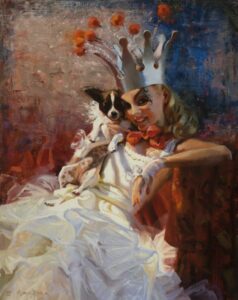
"Princess Zazu and Pip" by Nancy Boren

“Princess Zazu and Pip” by Nancy Boren

Maybe Henry David Thoreau had an experience similar to mine that caused him to say, “So we saunter toward the Holy Land, till one day the sun shall shine more brightly than ever he has done, shall perchance shine into our minds and hearts, and light up our whole lives with a great awakening light, as warm and serene and golden as on a bankside in autumn.” And who can resist the colorful image this conjures up—maybe a white horse in a grove of yellow cottonwoods?


If you feel there may be a hidden theme in your work, or some unrecognized essence, or you wonder how all your painting threads connect, I have a suggestion: block out some time for a lunch with a savvy artist friend and leisurely peruse each other’s portfolios. A fresh eye and a frank discussion may uncover a powerful current flowing just under the surface of your paintings.


Keep It Simple! Using a Limited Palette

"Garapatta Spring" by Kathleen Dunphy OPA 24x18

“Garapatta Spring” by Kathleen Dunphy OPA 24×18

When I first started painting, I’d walk into art supply stores and spend hours looking at all the different pigments and brands of oil paints available, and drool over all those luscious colors: aureolin yellow, cinnabar green, quinocradone rose (just the names alone made me buy them).  I’d load up my basket with dozens of tubes of paint and head home thinking that at last I had found the color that would make me a better painter. Age and experience are wonderful teachers, and I finally came to the conclusion that no special pigment would be the key to my success. In fact, the more choices I had on my palette, the gaudier and less-realistic my paintings looked.

In 2003, I had the good fortune to study with Scott Christensen, who at the time was using a very limited palette that he had his students use in his workshops. At first, I was baffled: how could I get a true yellow ochre using only 3 primaries and a couple of grays? How could I get a wide variety of greens when there were no green tube pigments on my palette? But after sticking with this limited palette for a while and experimenting with these colors, I came to see that I could mix just about every color in nature using only 6 tubes of paint. Using this palette also helped me to see and understand color temperature better by simplifying my choices: if the color needed to be warmer, I added yellow; for cooler, I added blue. And I found that the colors I was mixing were so much closer to the reality I was seeing than when I used a broader palette. When there are 20 choices on the palette, I find it’s much easier to just say “oh, that’s close enough” and dip into a color straight out of the tube , but when I have to mix my colors from the primaries, I get a more accurate representation of my subject matter. Of course, there are certain local colors that I can’t duplicate exactly with this palette, especially if I’m painting man-made objects. But I can always get the correct value and the correct temperature, and when those are right, the color reads correctly.
"Tahoe Bliss" by Kathleen Dunphy OPA

“Tahoe Bliss” by Kathleen Dunphy OPA

For example, the color of the water at Lake Tahoe is an incredibly intense blue-green. I may not be able to get that exact local color, but I can mix the right temperature and value, then surround that color with more muted grays and the color of the water will feel more intense and believable.

Over time, I experimented with adding and subtracting pigments from my palette and settled on the selection of paints that I’ve been using since about 2005. This is the palette that I use for all of my paintings, both plein air and in the studio:

Titanium White (any brand)
Cadmium Yellow Lemon (Utrecht)
Permanent Red Medium (Rembrandt)
Ultramarine Blue (any brand)
Naples Yellow Deep (Rembrandt)
Cold Gray (Rembrandt)

(Please note that the brands of the paints are very important as colors vary widely between manufacturers)


Although I use a limited palette for my paintings, I always start out by mixing puddles of several colors before I start the actual painting. Doing this accomplishes two things: it helps me to slow down and analyze the color before I dive headlong into painting, and it allows me to have an expanded choice of colors when I begin to paint.  I always mix the secondary colors (orange, green, and violet) regardless of what I’m painting, and the rest of the puddles of color are close approximations to what I’m seeing in the subject matter. Pre-mixing takes some time at the beginning of the painting, but it really saves time once I start to paint: I already have so many colors figured out and can concentrate on the subtle shifts in temperature and value that I’m seeing. Also, I don’t break the rhythm of painting to drop my brush, get out my palette knife and mix new color.

Here’s a shot of my palette before I start a painting:
Dunphy-Starting-Palatte

And here’s the finished painting from that palette:

"The Italian Store" by Kathleen Dunphy OPA 12x12

“The Italian Store” by Kathleen Dunphy OPA 12×12

There are certainly countless artists out there who use extensive palettes and get beautiful results, and my selection of pigments is just one way to approach painting. But if you have never used a limited palette, give this a try- you might be surprised with the results and be able to bypass all those rows of paint next time you’re in the art store.

Uber Umbers and Other Colors from the Earth

"Cleopatras Garden" by Margret Short OPA

Cleopatra’s Garden 28×22 oil Margret E. Short

Throughout the ages since the very first scrawls were made in caves and tribal hunting events were recorded on walls, people have been using colors made of ochres, umbers, madders, bugs, mummies, minerals, shells, iron oxides, and plants. These pigments decorated sheets of papyrus, vellum, paper, faces, bodies, fabrics, clothing, tools, leather, weapons, walls, ceilings, and stones far and near.

People perhaps just hacked a chunk off the cave wall and started noodling, or charred a bone from last night’s dinner, or took a stick from the fire and began to make marks. The earth itself for thousands of centuries has created a harmonious palette of archival and readily available colors to create some of the most beautiful and enduring art in the world.

"Metamorphosis" by Margret Short OPA

Metamorphosis 12×12 oil Margret E. Short

Today, artists around the world are still using many of those same pigments as used in the past. Thanks to specialty companies, we know more about the composition, archival quality, rarity, cost, permanence, transparency, opacity, toxicity, saturation, drying times, and source of these pigments — issues which are enormously important to artists.

This topic has become a passion for me over the recent years, and I have experimented with most of the available historical pigments in one way or another, creating several in-depth projects that involve both artistic and cultural research. The most profound characteristics discovered are that these pigments are splendid to work with and endlessly beautiful.

"Feluccas on the Nile" by Margret Short OPA

Feluccas on the Nile 7×5 oil on silver leaf Margret E. Short

Mother Nature herself has done the palette preparation work for me, as the natural subtle muted quality is all ready to go. Time has aged the ochres into dazzling arrays of warm and cool yellows that, when placed side by side, are instantly pleasing to the senses. The umbers work in the same way and come in stunning varieties of light, medium, and very dark, depending on the source. Lapis Lazuli, azurite, malachite, and ivory black comprise my list of favorites. Technically not an earth color, but manufactured by the ancient Egyptians, Egyptian blue frit is a clear crisp color used to decorate the dizzying riches of the Pharaohs.

Cinnabar in the Making

Cinnabar in the Making

Natural cinnabar, my favorite red mineral pigment, formed eons ago by a perfect marriage of mercury and sulfur is mined in Spain, Russia and the west coast of the US, including Oregon where I live. You can see the beauty in the muted hue, which is not garish at all.

To my eye, the modern cadmiums are so highly saturated they overpower my canvas and are difficult to handle on the palette. I find this true also of other modern colors such as phthalo greens and blues. Occasionally, when my mad-scientist self  gets restless, I break out of this mold and experiment with some of the modern azo, turquoise, and quinacridones, but I usually will spend time muting or graying them down in some way.

"Secret Life of Iris" by Margret Short OPA (detail-cinnabar, madder, white)

Secret Life of Iris 30×30 – Detail (cinnabar, madder, flake white)

Contrary to common knowledge, making hand-made paints is relatively easy once safety precautions are in place. All you need is a mask, a little oil, pigment, a grinding slab, and a muller. The dry pigment powder is mostly ready to go and just involves mixing in the oil to make sure all of the pigment disperses with the oil.

"Nefertitis Garland" Margret Short OPA (detail - Egyptian green frit)

Nefertiti’s Garden 12×5 (detail) (Egyptian green frit) Margret E. Short

Another common misconception is the natural pigments are too toxic to handle carefully. Actually, there are only a few that have warnings and with caution, those can be handled too. I always use a respirator and gloves while wearing a smock, and most importantly, I grind the paint in an area with no breeze such as a fan or blowing furnace vent.

"The Golden Age" by Margret Short OPA

The Golden Age 12×12 oil Margret E. Short

Rather than using orpiment, which is problematic and toxic, I use chrome yellow at the suggestion of Eric Hebborn, the infamous art forger. (He implemented this ploy when repainting over old canvases that he intended to sell as fakes). You can see chrome yellow mixed with cinnabar here on the tangerines in The Golden Age. The range of colors is amazing when using just a few earth colors. Rembrandt had about 20 in his repertoire.

It really is a process of elimination. I use just the colors that are safe after they are encased in oil and toss out the fugitive (many of the plant-based colors) or toxic colors. I use caution and strict hygiene habits while painting. Most importantly, the mere fact of having a few select colors on my palette to deal with allows easy and quick decision color mixtures.

More and more interest in hand-ground paints made from natural pigments is surfacing lately. I invite you to choose a few colors, (even if you do not grind the paint yourself,  purchase the ready-made), and experiment. Do some studies and see the difference in the surface quality of your canvas. Make that connection between you the painter, the aesthetic of your art, and your materials. The results just might be profoundly gratifying.